Update from the hackAIR team (October 2017)

From ordering material, debugging mobile apps and writing tutorials: we’re getting ready for the launch of the hackAIR platform. What is happening right now in Thessaloniki, Oslo, Amsterdam, Berlin, Athens and Brussels?

Eleftherios Spyromitros-Xioufis (CERTH)

“CERTH is currently working on ways to increase the amount of data that enters the platform. In addition to collecting geotagged sky-depicting images from Flickr, we now also collect non-geotagged images and try to infer their locations based on the image metadata. Our evaluations suggest that the approach works surprisingly well, being able to accurately estimate the geolocation of a significant percentage of non-geotagged images. We also have added more data sources: In addition to the PM measurements from governmental sources, we have recently started to collect measurements from luftdaten.info sensors.”

Gavin McCrory (VUB)

“The last 6 months have been a busy period for us at VUB! We’ve been bringing the ambitions of both pilots in Norway and Germany together with engagement lessons learned from air pollution projects, domain experts and over 400 citizens. In September, we developed our engagement strategy for hackAIR, which will guide and support pilots over the next year and a bit. Alongside this, we also developed the evaluation framework and behaviour change strategy for the hackAIR project. We’ll be presenting some of our lessons learned at the Internet Science conference (in Thessaloniki, Greece) next month. We’ll continue to explore channels to illustrate the results of our research, both online or in person; if you have any suggestions or ideas for how we could do this, please let us know!”

Hai-Ying Liu (NILU)

“At NILU we are doing lots of testing! Building up and testing the hackAIR sensors in the lab, testing the first version of the hackAIR web, the mobile app, and the hackAIR platform. The testing results will shared with hackAIR developers for update. In addition, we are preparing information and dissemination materials in Norwegian to contact potential participants. We are also preparing materials for the pilot training and testing for the upcoming case study in Norway, Germany, Athens and Brussels.”

Panagiota Syropoulou (DRAXIS)

“At DRAXIS we are coordinating the work of all partners so that we are ready to ignite the pilot activities within the following months. We are in regular contact with external experts in the fields of air quality, citizen science, gamification and user experience to ensure that citizens will enjoy the hackAIR experience and that our pilots will be successful. The development team is currently fine-tuning and testing the platform so that we will be ready to go public.”

Wiebke Herding (ON:SUBJECT)

“The ON:SUBJECT team is working behind the scenes to prepare for the launch of the hackAIR platform. In the past months, we’ve built a completely new website for the project, drafted tutorials, shot videos and reworked hackAIR’s visual identity. We’re also working on a set of workshop materials that you can use to learn about hackAIR and build your own air quality sensors. We’re not quite ready to show you any of this, but we can’t wait!”

What we know about air quality

Between May and July 2017, the VUB research group SMIT conducted a multi-language survey to explore the awareness and behaviour of citizens in the context of air pollution, as well as the interest to measure it. After the first data collection, close to 400 people from Norway, Germany and other countries gave their input, including 261 in German, 64 in English and 47 in Norwegian.

We found that levels of awareness about the causes of air pollution are high amongst our sample, who regard traffic, emissions from industry and burning from household activities as the three main sources of particulate matter pollution. Awareness levels about the associated impacts of air pollution were similarly high – the main adverse effects identified include threats to health, effects on nature and lower quality of life. However, citizens indicated that they are less informed about which individual steps they can take to reduce air pollution.
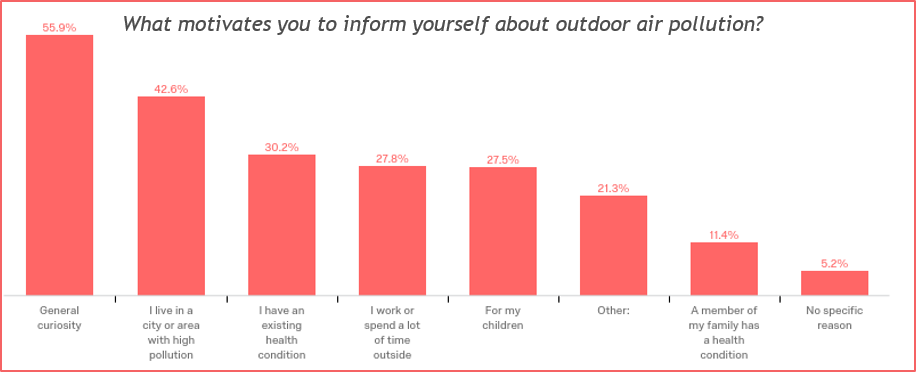
Our results pinpoint that people are generally curious about air pollution, and have an interest given their proximity to urban areas. This is also in line with the finding that people also regard pollution at the city level as a more clear and present problem than nationwide or neighbourhood specific pollution. We learned that traditional media channels such as newspaper, radio and television remain central sources of information about air quality. The value of digital channels also emerged, however, with one in four people benefiting from social media, websites and online platforms.

Importantly, our results show that citizens want to be engaged in policy dialogues and workshops around the topic of air pollution, and are interested in viewing and measuring data in real-time. They see value in connecting to related projects around air pollution, but also show that there are several challenges around the technical skills involved to build, measure or understand the data generated by low-cost sensors and our mobile application. For the next year, these points will underpin our approach to community-based engagement, focusing on real-time air pollution, support and training, and learning by doing in workshops.

If you would like to find out more about the hackAIR survey, feel free to contact Carina Veeckman from VUB-SMIT on carina.veeckman@imec.be.

Wearable air quality sensors

Kick-off meeting for the VERTIGO artistic residency on the 17th of October 2017 at DRAXIS premises in Thessaloniki. Guests: Emily Groves, representative of the VERTIGO project, Ling Tan, artist from Umbrellium, and Sarah Unwin, from FutureEverything that will co-finance the artistic work.

hackAIR was selected by VERTIGO as one of the research projects that will welcome an artist to work with them. The VERTIGO STARTS Artistic Residencies Program organises collaborations between artists and research and development projects in the field of Information and Communication Technologies (ICT).

The project that the artist will work on is called “Pollution Explorers”. It is a participatory project consisting of a set of wearable tools co-created with the hackAIR community, using the hackAIR platform to help citizens making sense of the complex issues around air pollution. It combines wearable technology, IoT, citizen participation and crowdsourcing and is intended to help investigate personal responsibility in air quality issues among citizens. With these technologies the artist will try to explore ways to measure people’s subjective perception on air quality and compare it with actual measurements of air pollutants.

The project will run from November 2017 until December 2018 and it will engage 2 groups of participants to co-create the wearables and monitor the local air quality. The scope of the project is to identify the correlation between citizens’ perception on local air quality and real air quality levels. From this residency, hackAIR will achieve greater visibility and engagement of citizens.


Air Sensing Roundtable: Initiatives for air quality and participatory sensing

The main challenges for air quality & participatory sensing include reliability of data, good communication with public authorities and strong community relations. These were the hot topics discussed by participants of the Air Sensing Roundtable webinar on 26 September.

With this webinar, hackAIR provided a platform for participatory sensing initiatives to discuss their approaches, experiences and challenges. What can we learn from each other? How can we join forces to increase citizen participation in air quality sensing?

Three initiatives shared their actions and learnings:

  • CAPTOR | collective awareness platform for tropospheric ozone pollution
  • Luftdaten.info | sensor toolkit to measure air quality with citizen science
  • hackAIR | open technology platform to access, collect and improve air quality information

In an in-depth discussion, participants active in the field talked about their main challenges and concerns. These include

  • Reliability, data validation and calibration;
  • Communication and relation with public authorities; and
  • Community relations.

Ideas for collaboration were pitched, links to related initiatives were shared and the path for further streams of dialogue for 2017 and 2018 was cleared. hackAIR will use this input to strengthen its launch in January 2018.

Are you a professional working on and interested in air quality and participatory sensing? Join our email list for the Air Sensing Network for more exchange and mutual learning.

Practice report: Testing the hackAIR sensors

Figure 1. hackAIR WIFI shield connected to the SDS011 sensor

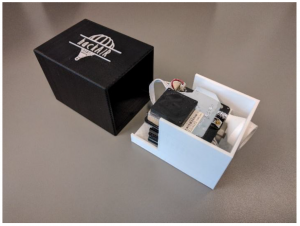
In spring 2017, a group of engineering students from the Oslo and Akershus University College of Applied Sciences (HiOA) evaluated a first prototype of the hackAIR home sensor and compared the measurements with reference equipment. After overcoming the initial struggle of getting the prototype to work, they conducted two measurement campaigns: one inside the lab environment, and one in the foyer of the school. For that purpose, they also created a 3D-printed case for their sensor.


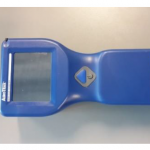
Figure 2. LAS-AIR II
Figure 3. Aerotrak particle counter

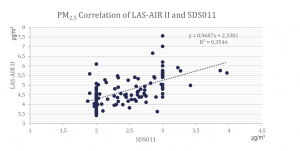
Compared to the reference equipment (a LAS-AIR II aerosol particle counter and an Aerotrak particle counter), the students found that measurements differed slightly, though within a reasonable correlation. Increases and decreases in air pollution were picked up correctly. In general, the PM10 measurements turned out marginally less exact as the PM2.5 data.


Figure 4. hackAIR prototype case with SDS011
Figure 5. PM2.5 correlation of the LAS-AIR II and SDS011 in the hallway


When using the sensor in the casing, the responsiveness of the hackAIR sensor decreased: That is why the final design of the hackAIR casing will need to ensure proper airflow towards the sensors.

Figure 6.  Measurement devices in the hallway of the first floor in P35 of HiOA

Thanks a million for this exploration, Lisa Marie Rickerts, Carter Barkley, Ryan Beacham & Leyre Ortiz García.

Ensuring quality measurements with the hackAIR sensing toolkit

With hackAIR, you can contribute to better information about air quality in your neighbourhood using a number of different tools. But how good are our data? What can we really say about air quality?

The general principle: official data as a foundation

To calculate the overall air quality map for a city, hackAIR supplements official air quality measurements with user-generated data. The outcome is a continuous map of estimated air quality. Similar to the weather report, we calculate probabilities and estimates for locations in which there are no official measurements. As our models are based on reference measurements, these will always dominate in case they contradict with user-generated data.

When you zoom in to a neighbourhood, you will see the individual measurements that have contributed to the overall estimate – both from official data and other sources.

Sky images to estimate air quality

When you take a picture of the sky, the specific shade of blue you see will vary depending on the air pollution. Using this principle, hackAIR calculates the so-called aerosol optical depth of publicly available and user-submitted images to estimate air quality, taking into account the specific location and time at which the picture was taken. Unfortunately, it is impossible to directly compare these measurements to exact PM10 or PM2.5 values. Instead, the hackAIR app is showing pollution categories (from bad to very good).

  • We mapped the air quality in Thessaloniki using sky photos and we compared these estimations with official measurements in the city. According to the results, our method is able to characterize the aerosol variability within urban centres and identify hotspots.
  • We are currently organising campaigns where we collect a quite big number of sky images taken from different devices so that we examine how the type of the camera affects the quality of the results.

Open hardware sensors

Testing the hackAIR sensors

Both hackAIR open hardware devices use the same component for air quality measurements: The SDS011 sensor. Generally, this component is seen as “the best sensor in terms of accuracy ” for low-cost electronics thanks to its larger fan and laser-based design. However, this does not mean the sensor is as accurate as official reference stations. A scientific evaluation of the SDS011  concluded that measurements are comparable for average humidity – high humidity and temperatures can cause less accurate measurements. The second version of the hackAIR home sensor will thus include a temperature and humidity sensor so that we can balance this effect.

  • The manufacturer of SDS011 sensor, Nova Fitness Co. Ltd., reassured us that the sensor is factory calibrated
  • We have placed some hackAIR sensing devices next to official stations and we are comparing their results.
  • We are testing the validity of the hackAIR sensing devices in laboratories using the Dylos Air Quality monitor.

Copyright 2021. All rights reserved

Take part in this short survey and help us improve your hackAIR experience.